What are we talking about today?

I'll get back to theme days once I find a groove of posting regularly. In the meantime, most of my posts are about some variation of books, bikes, buses, or Broadway. Plus bits about writing, nonprofits, and grief from time to time.

This blog is mostly lighthearted and pretty silly. It's not about the terrible things happening in the world, but please know that I'm not ignoring those things. I just generally don't write about them here.
Showing posts with label Movies and TV. Show all posts

01 January 2021

Hello, 2021 (please wipe your feet)

I thought it would be a good idea to bring in the new year by getting my digital life in order, or at least making a start at it. Now, an entire workday's time later, I'm taking a break from relentless unsubscribing.

Most years, there are two predictable sets of posts throughout the blogosphere to welcome the new calendar: the resolution posts, and the I-don't-make-resolutions posts. Both kinds are endearing in their own way, I suppose, but this year I would welcome them both as a harbinger of less-interesting times. Alas, our times remain interesting, and are likely to be so for some time to come.

I searched "goal" on free images, and got this. 1) They're not wrong; and 2) this is exactly the kind of metaphor I was looking for and didn't even know it. Photo by Julie Elliott-Abshire from FreeImages.

As for me, I am toying with a few goals for the year, but am in no hurry to get them set. (I'm waiting on results from a COVID test, anyway, so there's a chance I have some unexpected non-working days next week to think it over.) I'll probably land on doing monthly goals, which benefit from having a shorter time frame as a built-in anti-procrastination guard. I also like Gretchen Rubin's "21 for 21" idea, and have tossed that one into the hopper to see what comes out.

I've taken the odd moment over the last couple weeks to think over some things I used to do but don't now, and the reasons why I stopped. Two big life events seem to be the main culprits, and yet not the obvious one: when I went back to university in 2010, and when I dragged myself across 1000+ miles to start a new life in Cincinnati in 2016. Of course, 2020 itself bears some of the blame, since in the past few months it's been pretty easy to justify not doing anything extra. Some of the things I've lost along the way:

  • Watching basketball games on TV. I used to love watching basketball. This one got lost when I went to UT.
  • Watching NCIS and its many spinoffs. Ditto on losing this one to higher education.
  • Training well for half marathons. This one would be easy to blame on going to UT, and that is part of the reason, but the bigger problem lies in me jumping into a marathon too soon and never being able to find the spark since. And that's been a loooooong time. Don't get me wrong, I've continued to run half marathons at least once a year from 2008 up until 2020 shut everything down, but I haven't put in that same level of effort and intention, which I used to enjoy, in about a decade. I'm not sure I know how to fix this one.
  • Reading a lot. This one fizzled after I moved to Cincinnati, and the fizzling was compounded by 2020. Doomscrolling is way too convenient (and while the term is new, for me as for many, the practice is not).
  • Writing a lot. Another Cincinnati casualty, for some reason.

Is this a starting point for 2021 goals? Perhaps. I'm unlikely to return to watching a lot of TV, my fondness for Timothy McGee notwithstanding, but I can watch one or two Pacers games a week, methinks. Or perhaps it's time to acknowledge that I accidentally had that personality change that I always joke about having not had.

Whatever your choice for 2021--lots of resolutions, one or two goals, just hanging on tight to see what comes next--I wish you all the best for a year that goes your way more often than not. Indeed, I think that's the best we can all hope for.

28 February 2018

Unconvinced

I watched rather a lot of television in February, thanks to the Winter Olympics. So much, in fact, that I think I'm all TV'd up until the French Open. While it's not a hobby that I'm into, I do at least admire other people's resolve to sit still for that long. 

In the course of all that TV, I saw many, many car ads. That was a lot of car ads. Some of the tactics used to try to sell me a car are silly, some are funny, and some are downright wrong. For my amusement, I started keeping a mental list of all the people who were enlisted to sell me a car in the month of February:

Sharlie is not impressed by all these attempts to replace
her. She doesn't have anything to worry about, of course.
Oh, by the way, the Ohio River just had its biggest flood
in 20 years.
Dr. Martin Luther King, Jr.;
Jesus, Moses, and Muhammad;
Real people, not actors;
Sesame Street Muppets;
Six women on snowboards;
Every Paralympian;
Ashley Wagner;
A high school band;
William Henry Harrison; and
(my personal favorite, by a car company that is a sponsor of USA Bicycling, for heaven's sake)
Bicycles.
Needless to say, they were unsuccessful. Better luck next time, advertisers. Don't worry; I'm sure you convinced someone. Just not this someone.

You want to see a great ad, one I never got tired of seeing in two weeks of Olympics? Check out this one from St. Elizabeth healthcare. My favorite is the young man struggling with his math homework who's ready to give it another shot after his dad says, "You got this." Love.

22 August 2017

Slow Learners

There's an episode of Boy Meets World in which they parody themselves and poke fun at some of the show's many idiosyncrasies, and which includes one of my favourite lines of the entire series, when the Cory-Matthews-like character asks, "How can I learn so much every week and still be so stupid?"

Source.
 Y'all, Dr. John Watson is the Cory Matthews of 19th-century popular literature.

Source: Goodreads.
I'm nearly finished reading The Complete Sherlock Holmes, years after my only exposure to the written works being the occasional short story in school (whoever was responsible for my 12 years of literature textbooks really loved "The Red-Headed League"). It's been my bus and treadmill read since around March, so it's been slow going, but it's delightful to recognize some of the stories I've seen in other adaptations.

And then there's Dr. Watson. Seriously, John. I don't know if Conan Doyle liked Watson being dimwitted, or if John is filling a particular literary role that he can't be moved from, or if it's just reflective of the writing conventions of the time that John never learns a freaking thing over the course of many years of friendship with Sherlock. The one that finally had me shouting, "Come on, you idiot!" at my iPad was "The Disappearance of Lady Frances Carfax," when Sherlock sends John an offbeat telegram asking for a description of someone's ear, which John dismisses as a joke. John, listen, buddy. How have you known and worked with Sherlock this many years and still don't get that the weirder the question is, the more critical it is to the case? The more so considering that you once had a case that was all about ears, both attached and not. Dude. Use that head for something more than a hat rack, as my mother would say.

So I'm glad that the delightful Martin Freeman's John Watson on Sherlock does have some brains in his head and manages some learning and growth across the scant episodes we have to make do with. However (and with books this old, the "however" is inevitable), please be aware that Mr. Conan Doyle's works reflect some unfortunate attitudes of their time and place; that is to say, the racism, classism, and sexism are strong with this one. At times it's unreadably strong and I was knocked right out of the world of the story because of these uglier elements. If you're going to read this book, please know that before you go in.

And one more thing before I go: this Kindle version has formatting problems, punctuation problems, spelling problems that I'm almost certain were not in the originals, and no visuals in places where there should be visuals. (It reads "GRAPHIC" in those spots instead.) At least one Amazon reviewer says there are also missing paragraphs, which explains some weird shifts in the text if that's truly the case. So while the price is right (free), it's not without some issues, so proceed with fair warning.

22 June 2017

The Galling Sides

There's a little saying that tends to pop up a lot in social media land, often after a news story hits about a massive gaffe, but it also worms its way into everyday life. I've said it many times, and maybe you have, too. But these days just the mere hint of it is enough for me to roll my eyes and stop listening, and I'm writing this in part to understand myself why I'm so annoyed by one little platitude. What is it?

"There are two sides to every story."

Nice, right? Good way to remember that maybe the victim and perpetrator aren't as clear-cut as we were first led to believe. Good way to suspend judgment until all the facts are in. Good way to exercise the voice of reason in a volatile situation.

Here's the thing: it's not true.

Now I'm sure some folks have rolled their eyes and run off already. Maybe others are trying to pinpoint which thing in the news that I'm talking about. (I couldn't possibly pick one, so don't bother.) Someone is already writing their heated response to my obvious foolishness in their head. And all those reactions are exactly why the cute little saying isn't true, because there are waaaaaaay more than two sides to every story. 

Humans are complicated, y'all. We are big bundles of messy emotions and motivations and intentions. Think about all the times in Fiddler on the Roof when Tevye mutters to himself, "On the other hand... but on the other hand... but on the other hand..." It gets a laugh, every time, at how quickly he runs out of hands. Until the time when he finally explodes, "There IS no other hand!" and then it's tragic, not funny.

Saying "There are two sides," when in fact there are many more sides, is a cop-out. It can be a stand-in for "I'm not choosing sides yet" or for "I have an unpopular opinion about this" or for "I think you're wrong but I don't yet have proof" or even for "Maybe this isn't worth spending our time arguing about" without really conveying any kind of meaning. At best, it sounds wise and reassuring without saying anything at all. At worst, it sounds wise and reassuring while being a passive-aggressive disagreement that's hard to refute, because who wants to disagree with both sides' right to their own agency?

Even the most basic die has six sides. Humans definitely
rate more sides than that.
Source: Armin Hanisch on freeimages.com.
The problem with this kind of "wisdom" is that we already know we have more than two sides going on inside ourselves at all times; why on earth would a conflict outside ourselves have only two sides? I may think a problem is with a coworker (although please note that I have no such problems at the moment), when really it's much deeper than that, with roots in our separate interpretations of company policy, and our relationships with the boss or with other coworkers, and with resonances of how a situation was handled in the dim and distant past that we may not even realize are still bouncing off the office walls. So one day when it all comes to a head, the simplistic "two sides" may bring temporary harmony, but it doesn't address the roots.

It's nice to jump onto Facebook with platitudes and try to be a voice of reason. It's great to get comments about how levelheaded one's interpretation is of the headline du jour. It even feels good to score some points against a hotheaded friend who chooses sides at the outset and then turns out to have read the situation incorrectly. But it's also good to remember that human interactions aren't equations with one correct answer. Let's not pretend every outrage that hits the evening news can be solved by hashing out the two sides until we declare a victor (and then, as is the wont of humans, go on fiercely defending the side we liked better ad infinitum).

Withholding judgment until more facts are available is wise. It's okay not to know who was right and who was wrong. Not saying so--biting one's tongue (or fingers, since they do the typing)--is harder when the arguments are piling on and you suspect other people are wrong. But "there are two sides to every story" is still a cop-out, especially if it really means "I'm not ready to rationally discuss this." If I'm that interested and that invested in getting to the truth, saying "there are two sides" and leaving it at that is not going to get me there.

Post title is an homage to the Mathnet episode "The Case of the Galling Stones," which is about a gem shaped like a dodecahedron. I'm still a huge Mathnet fan, and while I loved Kate Monday, I adored Pat Tuesday.

02 May 2017

What I Read: April

I read three books again in April, which means my Goodreads Challenge is getting a bit ahead of me at the moment. Maybe now that I can stop dashing out my door a couple times a week to go take photos of places I've never seen before, I'll have a bit more time for reading. I hope.

So, here's what I got through in April. Books are in alphabetical order by title (ignoring articles, naturally; I'm not a barbarian). If you want to see them in a different order, let's be friends on Goodreads and you can peruse my shelves to your heart's delight. As always, book images and links are from Goodreads, and that's where you can read my reviews, too.


First-time reads:
Never Have Your Dog Stuffed: And Other Things I've Learned, Alan Alda
The Red Notebook, Antoine Laurain
Rich Christians in an Age of Hunger, Ronald J. Sider


Re-reads:


Books by women:


Goodreads challenge: 13 of 52 books in 2017


What are you reading?

05 April 2017

D is for Donut #AtoZChallenge

Join me on the A to Z Challenge: I'll share a different thing from my new home, Cincinnati, every day for 26 days in April.

Grilled cheese donut, that is:

Image source: CincinnatiUSA.com.
I have not tried this. In fact, I feel ill just thinking about it and if I look at that pic long enough I might get a contact migraine. But for all that they've spread across the country, Tom+Chee is a beloved local restaurant, and I acknowledge that many of my readers are probably happy to try this. So, lots and lots of props to Adventure Mom for taking the plunge and writing about it. If you want to know more about this as-seen-on-TV restaurant that may also be near you, she's your gal.

Maybe someday I'll be brave enough to try a grilled cheese donut.

18 March 2017

Again and Again and Again and Again

I had my Pandora set to one of my Irish stations at work yesterday and was singing along, as I do, when this song came up. I had to take a break because it came at the end of a long succession of sad songs--the bit about leaving a wife or sweetheart behind gets me every time. But that's okay, because crying at my desk is totally a thing I do now, even if it frightens the coworkers.

"Green Fields of France" is sad from beginning to end, not the least because its message of the never-ending nature of war. Willie McBride's death didn't help every generation since, no matter how badly he may have hoped it would:
But here in this graveyard that's still no man's land
The countless white crosses in mute witness stand
To man's blind indifference to his fellow man
And a whole generation were butchered and damned

And I can't help but wonder oh Willy McBride
Do all those who lie here know why they died
Did you really believe them when they told you the cause
Did you really believe that this war would end wars
Well the suffering, the sorrow, the glory, the shame
The killing and dying it was all done in vain
Oh Willy McBride it all happened again
And again, and again, and again, and again
I learned this song from The High Kings, most likely on PBS, since that's where I tend to see The High Kings, but plenty of Irish bands sing it.


Related to my other interests: Someone's done a Les Misérables version of this song. Yes, please. Also, if you like The High Kings, see an entire show here (I believe this is the one that's usually on PBS).

13 March 2017

Quantitative Methods

Monday is usually the day I blog about running. Here's how my running is going:


With that out of the way, let's talk writing instead. Well, creating. I default to writing because that's kind of my thing, but I'm pretty sure this applies to other types of creative processes.

Are people still debating over quantity vs quality? I kinda checked out of that one sometime in the 80s (yes, I got an early start on this) after a series of teachers telling us to focus more on the quality of our schoolwork were matched with another series telling us that we'd get the quality only if we upped our quantity, i.e., with more practice. Yes, these were the kinds of lectures that went down at Weston Elementary School.

Anyway. I don't know if that debate is still raging, or if it's settled now, but my experience has been that the second group of teachers were correct, and quantity of creative output will result in an increase in quality over time. There are almost certainly exceptions to this, but practice really does, more or less, get you closer to perfect.

Kim Liao sets a goal of 100 rejections per year, because to get that many rejections means she has to do a lot of writing, and some of that writing is eventually going to find its way to the right publication. Upworthy, the website, encourages its writers to embrace failure as part of the road to going viral.

I said this to two different coworkers last week. They both
reacted the way you'd expect highly qualified and
dedicated mental health professionals to react, which is
why I gotta stop quoting The West Wing at work.
Source.
So I was already feeling well validated in my decision to blog every day, or at least as close to every day as I possibly can, even though some of these posts are bound to be duds. And then I was listening to an episode of The West Wing Weekly podcast with Aaron Sorkin as a guest. Mr Sorkin said a couple things that I find both amazing and comforting: 1) most of the time his first drafts were what they filmed (what???), and a lot of times they sucked, and he would like to have them all back again to rewrite; and 2) after finishing nearly every episode, he would realize that his well of ideas was run dry and he had used up all his words.

And this is Aaron Sorkin. The guy who has written some of my favourite lines of all time. If an award-winning writer can feel this way... well, I choose to let it give me hope instead of despair. And given how prolific he is, he ought to know something about the byproducts of quantity, and about the words turning up when they're needed most.

What are you practicing today?

11 March 2017

More Rubbish

Related to what I shared yesterday--this set of images from a popular news network has been doing the rounds on social media this week. Actual complaint that so many poor people would dare to own refrigerators. You have got to be kidding me.

If these tomatoes go bad, they can always get a second life
being hurled at a jerk. (Don't put your tomatoes in the
fridge, though. That's not good for them.)
Source: Michal K on freeimages.com.
Yes, because having to throw out food because it went bad and end up spending even more of their too-tight budget just to keep their family fed is exactly what we should be expecting poor people to do. Because then we can judge them even more! What's the fun in being alive if we can't look down our noses at others?

Not that I think the other complaints in that photo set are any more valid, but this one is especially egregious. Why would someone seriously consider a refrigerator a luxury? Get a tighter grip on your indignation. We have real problems to solve and real needs to meet--there's no need for anyone to go around inventing ways to show off how uncaring they can be, not when we have ready-made ones to choose from.

Related to my interests: I notice that cars, which are a huge drain on a family's budget, are not listed. Because maybe it would be a step too far for a major news network to acknowledge that making car ownership a requirement for full participation in U.S. society is a burden to low-income families? They might have to give air time and serious consideration to real alternatives, and it might end with them calling on cities and states to make transit and bike/ped funding a priority. And goodness knows we can't have that.

10 March 2017

Pure Rubbish

The average American produces 4.5 pounds of trash per day. 4.5 pounds. (Some sources put it closer to 5.) That's a lot of rubbish, y'all.

Oscar is all of us.
Source: Muppet Wiki.
(There's a Muppet Wiki, y'all!)
Recycling takes a bit of a chunk out of that, and that's a good thing. But. But but but. There's a reason why "reduce" is the first step of the triangle. Recycling is great. Reusing is golden.

But reducing--that's magical. And not only because it lets you live lighter on the planet. It's also less stuff in your life--fewer things to keep track of, fewer things to pay for, less buyer's remorse, less stress over credit card bills--reducing can just make life a tad easier. And there's nothing not to like about that.

This is one time when it's great to be below average.

09 March 2017

Theatrical, Too: It's What We Do

Today's post is nothing but gushing praise for the local theatre scene, so save yourself while you still can.

I tweeted that this was as close as I was going to get to a
selfie with Brian d'Arcy James. He originated the role of
Nick Bottom and left the show last summer, but he's still
on all the promotional posters. 
Still here? Excellent! I've now bought tickets to three Broadway touring shows and visited the Aronoff Center soon-to-be three times, and every single person I've encountered so far has been wonderful. The box office staff, the ticket agents on the phone, the ushers--every single one of them should get their own standing ovation. I can't say enough good things about them, and they've gone a long way toward making me want a season ticket next year. Even farther than the promise of first dibs at Hamilton tix. (I'm debating a Broadway season ticket vs a Cincinnati Shakespeare season ticket vs a Blu-ray player so I can finally watch my LOTR extended editions. Stay tuned.)

Pretty close, yeah.
Last weekend I was gloriously reunited with the spectacular Something Rotten, which I've waited seven loooooonnng months to see a second time after I saw it on Broadway last summer. It was every bit--every inch--as wondrous as I remembered. I was pretty close to the front, so I could see all the actors' faces (also all their spitting), which is a nice improvement over last time. The principal actors are brilliant, the ensemble is a delight, and the jokes are fantastic. If it's coming near you, please go see it and be prepared to laugh a lot.

Also better than last time: I was surrounded by people who were also getting all the jokes, which was so much more fun than the calm and collected folks I was sat next to in NYC. After accidentally choosing a dud audience night for my Austin season tickets, I'm so happy to have been surrounded by audiences who came prepared to immerse themselves in the experience every time I've been to the theatre in Cincinnati. I can get used to this.

That's my delighted Cincy gush. What's an amazing thing about your town?

Post title is a line from the opening song in Something Rotten, "Welcome to the Renassiance."

02 March 2017

Tell the Best Story

I seem to find a lot of use
for this photo.
I'm kind of a halfhearted podcast listener, because most of my hobbies are ones that engage my brain in such a way that I can't turn on a podcast at the same time and really give attention to what I'm listening to. However, when I remember, I start my day with Theater People (I know you're all surprised to hear that). Last weekend I listened to the interview with Kevin McCollum, who produced (among many, many others) Rent, Something Rotten, In the Heights, Motown the Musical... a whole bunch of things I like, in other words.

Towards the end, he said something that took my breath away with its depth of truth and I had to lie down just to absorb what he'd said. (See? This is why I'm not good at listening to podcasts.) And then write it down to share with you. This interview was last summer, before the election, but has only grown more relevant in the intervening months. (Emphasis is mine.)
When you take arts out of the public schools, those young people grow up to be adults, and they look at conflict resolution only in a sports model. And that's what we're seeing in our government. We have three branches of government, it's a balance of how we tell the best story, and that's called a collaborative art form. Our government is a collaborative art form. Unfortunately, when many of the people running our country were younger, arts were not valued in their communities, because of money. But sports were. So what do you learn in sports? To win games, you have to have a good defense. We are running this country purely on defensive tactics. We have to start having an imaginative storytelling: how do we live better as a world? America used to have the best story. If we're in a sports model, we're not telling a story. We're just trying to beat each other. Let's stop that. Let's get back to storytelling. Let's collaborate, because collaboration creates the bottom line, not money.
 He's not wrong, y'all. Not only is all this mentality of winning at all costs bringing us gridlock and wasted resources, not only is it contributing to the deep ideological divides that keep people from even having reasonable conversations with one another, but it's also only spurring folks to dig in to their positions even deeper and lob ever nastier shots at the other side. This is why the arts matter--why literature and music and painting and theatre and sculpture are worth our while. Because they expand our minds and open us up to other ways and ideas and points of view. Because they hold a mirror up to our humanity. Because they connect us to other people. Because they ask us to tell a story.

This project at the Guggenheim was meant to be
books that were never written. Don't let that be you.
Write your part of the story.
I had an incredible literature class my senior year of high school, and I couldn't even tell you the name of it or what the theme was now, but I do remember this: by the end of the semester, our teacher pointed out that as a result of the works we'd read and the discussions we'd had, every member of the class had come to see ourselves as artists. (She had asked for a show of hands to this effect on the first and last days of class.) This was the gift she gave us, as newly minted adults about to make our way in the wide world: she invited us to join in the great story of humanity and write our part.

I should look her up and send her a thank you.

16 February 2017

Things Nobody Tells You Before You're Widowed

My dearest wish for all of you is that you and yours live long and healthy lives together and are only parted, if parted you must be, when you're old and grey and have a reasonable expectation that one will follow the other in short course anyway.

I knew all those photos I took at
the cemetery were going to
come in handy.
Unfortunately, I'm in a position to know that it doesn't happen that way for everyone. And since I do know that, here's my list of things you need to do to make your life easier should the unthinkable happen. Just do them, get it over with, and then put the evidence away praying you'll never need it.

1. Everybody's name should be on every account.
I had to send death certificates to the most unlikely of places--my phone company, for instance--to get customer service to even talk to me, because most of our stuff was in Chadwick's name. (For entirely un-sexist reasons, I would add; I was the primary breadwinner so he took care of stuff like talking to the electric company.) It never occurred to us that we were effectively locking me out of all our accounts. In fact, if you have a next of kin who you trust, having a third authorized person on the account who might be slightly less distraught and more clear-headed for speaking to your rubbish collector is a good idea. Also, this seems as good a place as any to point out that you'll have some extra paperwork to do at tax time for a couple years. (Death and taxes, though--the IRS has customer service folks who are great at this. Call them. They're so kind and incredibly helpful.)

2. Similarly, share your passwords. To everything.
I mean, if you don't already have access to each other's accounts anyway, that's probably something you should talk about. I'm all for respecting each other's space, but to keep passwords secret is to invite some problems in. However! The real point here is that if you're felled by serious injury, hospitalization, or worse, your spouse will probably need to get into your computer sooner or later. Make sure passwords are stored somewhere everyone can get them.

3. Any special instructions/bequests need to be written down.
I'm lucky enough not to have had interfering relatives on either side of the family. (Of course, they were all far away, so...) But if you think there may be a relative, friend, neighbor, etc. who will muscle in at the worst possible time to claim Great-Aunt Myrtle's antique vase as his or her own, make sure your spouse has some ammunition to fight back. People as young as I am may not want to go to the bother and expense of writing a formal will (unless you have a condition that you know will shorten your time on this earth), but at least write some stuff down.

4. Know your rights.
I can't speak to same-sex couples, couples of different nationalities, common-law marriages, separated/blended families, or others that are outside my experience, so I urge you: do your research for your particular situation and make sure all your bases are covered. Y'all may be in need of legal documents that I didn't necessarily have to have.

5. If you have any ideas for a final send-off, it's never too early to say so.
The only things Chadwick and I talked about ahead of time were donating organs and the tree-planting thing. The first one obviously had to be dealt with right away, but I still haven't planted a tree (I have three places in mind, but haven't spoken to any of the property owners about the possibility of putting a memorial tree there. It's not like he's going to get any less dead, right?). We ended up having a Lord of the Rings-themed funeral, not on purpose, but we're pretty sure it's exactly what he would have wanted. Here's a hint: building a barricade at my funeral would not be inappropriate.

6. You're not going to be ready for the stupid stuff people say.
Similarly, your experience will not stop you from saying stupid stuff in your turn next time tragedy strikes someone you care about. It's part of being human, so unless it's a person who has a history of being thoughtless/causing trouble/etc., and as long as they don't repeat the ugliness over and over, let it go. If it's either of those two things, it's okay to reduce or cut off altogether the time you spend with them.

7. You're not going to be ready for the outpouring of kindness.
Tell the first person who asks, "What can I do?" to bring over some tissues. You're going to need them for more than just the obvious reasons. Humans can rise to amazing heights when called to it. Be willing to let people do things for you that you can't do for yourself.

8. You're going to need a Keely.
Any you can't have mine! A good friend who is a solid rock in times of crisis is invaluable. Keely could take on all nine Nazgûl by herself and come out having kicked some undead backsides into oblivion. You shouldn't be going through life without a Keely, anyway, so get to work on finding one of those. (And on being one of those for someone, of course.)

9. Dying is expensive.
Your bank account is going to take a ding. It's a bummer, but it's true--those of us under 50 generally haven't started paying for a funeral, burial plot, etc. I managed a funeral on the cheap, so it can be done, but you'll still have to shell out some cash. Even for younger and/or childless folks, a small life insurance policy may be worth it to cover final expenses should the worst happen. (If you have children, you should already have a policy.) Your credit score will likely fluctuate as well when you change all your joint accounts to individual ones. Also, that bill you get for the final ambulance ride/ER trip/DOS pronouncement is going to be the worst bill of your life.

10. You have hidden depths within you.
I still hear "You're the strongest person I know" or some variation thereof from time to time. While I do think the folks saying that must not know many people, I appreciate the sentiment behind it. Comparatively speaking, I had it easy--no children to parent through grief, no house to decide to keep or not, no meddling or blame from the in-laws (and I've heard some horror stories on that front!). Your journey, if it comes, may be harder. But you have the strength within you to walk the path, as awful as it is.

07 February 2017

What I Read: January

Here's what I read in January.

Books are in alphabetical order by title (ignoring articles, obvs). If you want to see them in a different order, let's be friends on Goodreads and you can peruse my shelves to your heart's delight. As always, book images and links are from Goodreads, and that's where you can read my reviews, too.


First-time reads:
The Jane Austen Handbook: A Sensible Yet Elegant Guide to Her World, Margaret C. Sullivan
An Old-Fashioned Girl, Louisa May Alcott
Stardust, Neil Gaiman
The Twelve Days of Dash and Lily, Rachel Cohn, David Levithan


Re-reads:
Dash & Lily's Book of Dares, Rachel Cohn, David Levithan
The Twelve Days of Dash and Lily, Rachel Cohn, David Levithan (Yes, I read it twice.)


Books by women:
The Jane Austen Handbook: A Sensible Yet Elegant Guide to Her World, Margaret C. Sullivan
An Old-Fashioned Girl, Louisa May Alcott
Dash & Lily's Book of Dares, Rachel Cohn, David Levithan
The Twelve Days of Dash and Lily, Rachel Cohn, David Levithan


Goodreads challenge: 4 of 52 books in 2017

28 January 2017

After All

We have to live in a world without Mary Tyler Moore now? Geez, that sucks. Hang in there, Carol Burnett!

Yeah, like there was a chance I grew up in
the U.S. without having ever seen the best
title sequence in TV history.
Source.
Ever since I announced my plans to leave Austin, taking my 30-something newly-single self to a city that didn't have my husband's footprints all over it, with the hope that a job and apartment would turn up when the time was right, I've endured a steady stream of Baby Boomers bringing the Mary Tyler Moore references. "You're Mary Richards!" they said, or "Are you going to get a job at a news station?" or the somehow even less subtle "Do you have a hat to throw in the air?" And then they inevitably follow it up with, "But of course you're too young to know what I'm talking about." Baby Boomers, y'all are lovely and wonderful on a case-by-case basis, but as a group you have a bit of a hivemind thing going on. You might want to look to that.

Anyway. Of course I knew what they were talking about, and while I watched the show when I was too young to really get it, I do own many hats. (Throwability of some of them is unknown.) And of course, it wasn't her iconic hat, it was her slacks that were the critical part of her wardrobe, back in the 60s on The Dick van Dyke Show, when TV execs didn't know that women owned trousers. I have plenty of those, too.

We'll miss you, Mary. Thanks for using your talent to make the world a brighter place. And for wearing such a great hat.

27 January 2017

Today's Topic is Pretty Obvious

One of my favourite lines from The West Wing (a show from which I have many, many favourite lines) comes from S3E2, when a frustrated campaign staffer shouts at the regular West Wing staff, "You people are never happier than when you're educating the public!"

Indeed.

You know who else enjoys educating the public? NASA. The National Parks. The USDA. The EPA. Researchers who rely on grants and whose findings are often taxpayer-funded. Want access to all this wealth of information? Call your elected officials and express your frustration about things like gag orders, hiring freezes that leave offices unstaffed, cabinet members being appointed with no qualifications to run some pretty important departments, data being withheld subject to the whims of politicians, and whatever new thing comes up today. The USDA's gag order was already lifted after public outcry. Let's keep it up.

Columbia River, 1973 vs 2012.
Image source: US EPA Ungagged.
Because having an educated public is critical, and we can't be educated without access.

17 January 2017

Best Books of 2016

As promised, the top five books that I read last year. Of course, this is highly subjective and my loving a book is no guarantee that you will. Please note that these aren't necessarily books published in 2016, but rather books I read in 2016. I'm not that fancy.

I read 112 books in 2016 (I had a lot of free time while I was funemployed), rated 32 of those with five stars on Goodreads, and had to narrow it down to five. Yikes! So here we are, my favourite books from 2016 (all images are from Goodreads):


5. The New Jim Crow: Mass Incarceration in the Age of Colorblindness, Michelle Alexander

When a Supreme Court justice quotes a book, it's good to pay attention. This is a book that will fill you with anger and despair (I hope!) and, if it doesn't inspire you to push for change, will at least tell you something has gone horribly wrong.


4. As You Wish: Inconceivable Tales from the Making of The Princess Bride, Cary Elwes & Joe Layden

If I hadn't already had a crush on Cary Elwes (and come on, who doesn't?), this book would have done it. If you're a fan of the movie, a fan of Mr. Elwes, or a fan of moviemaking, be sure to pick this one up. I've heard Mr. Elwes reads the audiobook himself, in that lovely lovely accent of his, so it's on to-listen list.


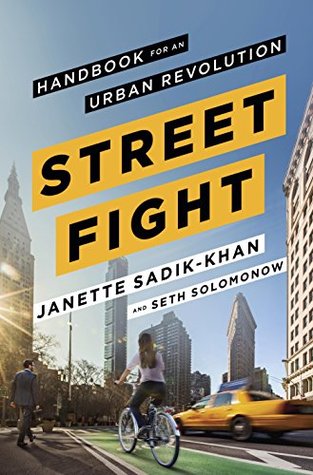
3. Streetfight: Handbook for an Urban Revolution, Janette Sadik-Khan & Seth Solomonow

The revolution's happening in New York! Yes, okay, that line technically belongs with book #2, but it also applies to this one. Active transportation dominates NYC, and Ms. Sadik-Khan worked as transportation commissioner to make the streets of NYC reflect that reality. The work is hardly done: in 2015 alone, reckless NYC drivers killed at least 16 people who were either on a sidewalk or in a building, for goodness' sakes, and many, many more who were lawfully in a crosswalk or bike lane. (Or even unlawfully--jaywalking is not, after all, a capital offence, nor are drivers authorized to impose said sentencing themselves. Yet.)

Regardless of the work yet to be done, Ms. Sadik-Khan planned and worked and pushed and cajoled New York into being a slightly better place for people who aren't in cars, and having visited some of the changed roads and plazas myself, I'm a fan. Read the book to find out more and be amazed.


2. Hamilton: The Revolution, Lin-Manuel Miranda & Jeremy McCarter

Despite my disclaimer, I managed two books in a row that were published in 2016. How about that. Enjoy the cast album? Enjoy Lin-Manuel's sense of humor? Enjoy not spending thousands on a ticket to a Broadway show? Read this and wait patiently with the rest of us for the day when Hamilton will finally be on tour and/or affordable to see in person. And laugh. Lin-Manuel really is a funny guy.


1. Incidents in the Life of a Slave Girl, Harriet Jacobs

Our legacy of slavery can feel like the distant past, but to not see that it reverberates all around us today is to be willfully ignorant. Bring your whole heart and your mind to this book and let it teach you. Did you read it in school? Good. Read it again.

Runners-up:


Brailling For Wile, Jamie Zerndt
The Fault in Our Stars, John Green
Streetlights Like Fireworks, David Pandolfe


Want to see more of what I read in 2016? Check out my Year in Books on Goodreads.

01 January 2017

On the Eighth Day of Christmas

For the 12 Days of Christmas, I'm sharing second, third, or otherwise not-first verses of popular Christmas carols.


In the Biblical account and every dramatization I've ever
seen, the sheep remain remarkably calm throughout
the whole "angels in the sky" thing. Makes me wonder if
they'd met the angels before. "Oh, yeah, Gabriel.
 He likes these dramatic announcements. Gives him
a reason to wear his fancy angel robes."
Image source: A Berg on freeimages.com.
"Angels We Have Heard on High"

By: We don't know. The most widespread English translation is by James Chadwick.

Written in: We don't know that, either, except that it was in Languedoc, France, sometime before 1862. (There seem to be a great many things about Christmas carols that we don't know, which I suppose is appropriate for a holiday that was appropriated from a pagan feast in an unlikely season for Jesus to have been born, and which is presided over by a jolly and chubby version of a 4th century saint.)

I have thoughts: I love, love, love this song, not the least of which because it's great for altos to sing. We have our own melisma (I'm delighted there's a word for that!) in the chorus, which alternates with the sopranaos' more well known melismas. Also, I just love the tune in general. There are some Christmas tunes (see also "O Little Town of Bethlehem" or "It Came Upon a Midnight Clear") that seem haunting, more evocative of the long road that Mary and Joseph traveled and more foreshadowing of the lonely road ahead for Jesus. And this is one of those for me. Your mileage may vary, of course.

Verse: In the excellent film The Trouble with Angels, Mary Clancy is stuck at the convent over Christmas break and she sneaks into Christmas Eve Mass to watch the sisters. Reverend Mother sees her, of course, because Reverend Mother sees everything, but leaves her alone to watch instead of sending her away. This is the verse they're singing (if I recall correctly) during that scene. It's the third verse. (Incidentally, The Trouble with Angels is on my very short list of movies that I prefer to the books they're based on.)
Come to Bethlehem and see
Him Whose birth the angels sing;
Come, adore on bended knee,
Christ the Lord, the newborn King.
Watch:


Sources:
Wikipedia
Metro Lyrics

28 December 2016

On the Fourth Day of Christmas

For the 12 Days of Christmas, I'm sharing second, third, or otherwise not-first verses of popular Christmas carols.

As a Doctor Who fan, I'm a bit nervous of angel statues,
but what else could I possibly use for this song?
Image source: alberto cavazzano on freeimages.com.
"It Came Upon the Midnight Clear"

By: Edmund Sears

Written in: 1849

I have thoughts: I chose this one for today because today is my grandfather's birthday (he would have been 91). Not that Grandpa particularly liked this song; I don't know how he felt about it. Here's what I do know: there was a made-for-TV movie by the same name that came out in 1984, when I was six. He and I watched it together.

In the movie, a man dies a week before Christmas but protests when he gets to heaven that he needs more time with his grandson, so they give him until Christmas Eve. (That's what I remember. IMDB has more details.) At the end of the movie, the man dies for good, having spent his final week making his grandson's Christmas amazing. Also at the end of the movie, Grandpa and I were both crying.

So this song has made me think of him ever since, even though we never talked about that movie ever again. Isn't it amazing how I manage to make every freaking thing sad? Quick, name a happy thing and I'll see if I can sad it up for you.

Verse: I couldn't choose between verses three and four, so let's do both.
But with the woes of sin and strife
The world has suffered long;
Beneath the angel-strain have rolled
Two thousand years of wrong;
And man, at war with man, hears not
The love song which they bring; –
O hush the noise, ye men of strife,
And hear the angels sing!

And ye, beneath life's crushing load,
Whose forms are bending low,
Who toil along the climbing way
With painful steps and slow,
Look now! for glad and golden hours
Come swiftly on the wing; –
Oh, rest beside the weary road
And hear the angels sing!
Watch:


Sources:
Wikipedia
Hymns and Carols of Christmas

20 December 2016

This Is What Reading Will Get You, Kids

The Sound of Music was on TV Sunday night, and since I've seen the movie enough times that I don't have to watch that closely to know exactly what is going on, I joined the Twitter love fest for snarking purposes. As I do.

We got to the point where Georg tells Maria to get the children together so they can flee the country, and I tweeted this:

Maria Trapp had three children after
she and the captain married, in case
you're counting humans and wondering
where the extra ones came from.
Image source: Goodreads.
Yeah. This is definitely my most popular tweet of all time. (I was also pretty happy with my second most popular tweet of the evening, but it doesn't really come into the whole fleeing Austria thing.) Some responses to this tweet have been predictably bizarre, but rather than give the nutters any more air time than Twitter already gives them, let's talk about that part of the book. Because it's book day here at Cheekyness.

Georg received his offer to rejoin the Navy. (In the book, he wrestled with the decision of whether to accept, unlike the instant response he has in the movie.) Rupert, the eldest, received an offer to take a responsible position in a hospital in Berlin almost immediately after finishing medical school. Then the family received the invitation to sing at Hitler's birthday.

Because the movie timeline is quite compressed and accelerated vis-à-vis real life, the children in the movie have only aged a couple months since Maria first met the family. However, when it was really time for the family to respond to these offers, the children as we know them were either grown or in their late teens. Georg called the family together, went over the invitations they'd all received, and asked what they wanted to do. They all agreed to say no, knowing they would have to leave home and homeland behind, willing to draw on their deep faith that God would hold them in His hands.

They got a train to Italy a few days later (just in time before the borders were closed), contacted a manager who'd previously invited them to do a concert series in the US, and were on a boat to New York within a few weeks. The entire rest of the book is about their adventures in adjusting to a new country: learning a new language, deciding to become US citizens (after the boys were drafted by the US army), buying a farm in Vermont, and other parts of life in a huge, singing, touring family.

I've said it before and now I'm saying it again: if you love The Sound of Music, get yourself to a library and pick up this book. Also check out books by other members of the Trapp family, to get even more perspective on the family's history.